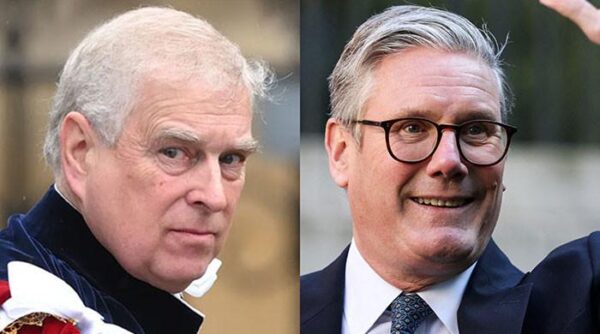
The future of Andrew Mountbatten Windsor is hanging in the balance as political pressure intensifies in Westminster. Discussions within government circles suggest that dramatic constitutional steps could soon redefine his position within the monarchy.
At the center of the storm is Keir Starmer, whose government is reportedly examining whether legislation could remove Andrew Mountbatten Windsor from the line of succession. Such a move would represent one of the most extraordinary constitutional interventions in modern royal history.
Sources indicate that any legislative action would only proceed after ongoing police investigations reach their conclusion. Officials are said to be carefully weighing the legal and political implications before taking such a historic step.
Andrew Mountbatten Windsor currently remains eighth in line to the throne despite being stripped of military titles and royal duties. The controversy surrounding his links to convicted financier Jeffrey Epstein continues to cast a long shadow over the monarchy.
Since stepping back from public duties in 2019, Andrew Mountbatten Windsor has maintained a low profile. His withdrawal followed a widely criticized interview that intensified scrutiny and damaged public confidence.
The proposed removal from the succession would require an Act of Parliament. In addition, approval would be needed from Commonwealth nations where King Charles serves as head of state, underscoring the complexity of altering royal protocol.
The last major reform to succession laws came with the Succession to the Crown Act 2013, which modernized inheritance rules. An outright removal from the line has not occurred since the abdication crisis involving King Edward VIII in 1936.
Senior officials have reportedly emphasized that due process remains paramount. The government is said to be determined to ensure that any decision aligns with constitutional principles and public interest.
Read More: Prince William Kate Middleton’s Bold Move Set to Transform Palace Life
Political reactions have varied across party lines. Kemi Badenoch has urged patience, insisting that police investigations should conclude before lawmakers consider further action.
Meanwhile, Andrew Bowie suggested that it would be the decent course for Andrew Mountbatten Windsor to voluntarily step aside from the line of succession. His remarks reflect growing calls for accountability within public life.
The debate extends beyond one individual. It raises fundamental questions about transparency, responsibility and the monarchy’s place in a modern democratic society.
Legal scholars have noted that removing a royal from the succession would set a powerful precedent. Such a decision could redefine how flexible the constitutional monarchy can be in response to controversy.
For King Charles, the situation presents a delicate challenge. Balancing family loyalty with institutional stability is no easy task, particularly at a time when public trust is under scrutiny.
As investigations continue and political discussions advance, the monarchy remains under intense observation. The eventual outcome could reshape perceptions of royal accountability for generations to come.
In the end, the question is not only about Andrew Mountbatten Windsor’s future but about how Britain’s constitutional framework adapts to modern expectations. If legislation moves forward under Keir Starmer’s leadership, it may mark one of the most consequential royal turning points in decades.